

Views: 0 Author: Site Editor Publish Time: 2026-08-28 Origin: Site


Many trainees eventually hit a frustrating plateau in their fitness journeys. They rely entirely on fixed-track resistance machines or simple bodyweight exercises. While these tools offer a safe starting point, they inherently limit your progression. Fixed machines stabilize the heavy load for you. This artificial assistance limits functional carryover to your daily activities. It also severely restricts your body from experiencing a natural, full range of motion.
Moving away from these restrictive machines is a highly effective choice. Framing this transition properly is essential for long-term success. You are not just attempting to lift heavier loads. You are making a vital investment in your neuromuscular coordination and core stability. You are also unlocking massive home-gym scalability. You will discover how different movement tools challenge your physical limits in unique ways. We will guide you safely through this rewarding fitness transition. You will learn the exact evaluation criteria needed to build a resilient, capable body.
Free weights demand greater activation of stabilizing muscles compared to fixed machines, delivering a higher metabolic and functional ROI per session.
Different modalities (Dumbbell, Barbell, Kettlebell, Macebell) solve different fitness constraints, from absolute strength building to rotational mobility.
Initial adoption requires prioritizing biomechanical form over heavy loads to mitigate injury risks.
For home environments, evaluating equipment based on the "footprint-to-versatility" ratio is critical before purchasing.
Fixed resistance machines lock your body into rigid, predetermined movement paths. The machine decides the exact arc of motion. Your joints simply follow along. This setup isolates specific muscles effectively but ignores natural human movement. Using Free Weights introduces multi-planar movement. You can push, pull, and rotate loads in three-dimensional space. This biomechanical freedom accommodates your unique skeletal structure. Your joints dictate the safest and most efficient path. You avoid the repetitive stress often caused by forced, unnatural machine trajectories.
Balancing a free-moving load demands intense physiological teamwork. You recruit secondary stabilizing muscles just to keep the weight steady. A chest press machine only requires chest and tricep effort. A similar free-weight press requires shoulder stabilizers, back tension, and forearm grip. You also engage the core by default. Your abdominal and lower back muscles must fire continuously. They prevent your torso from twisting or collapsing under the load. This mandatory stabilization builds dense, highly functional muscle tissue.
Physical footprint remains a major constraint for home gyms. A single-purpose leg extension machine consumes a massive amount of floor space. It only trains one muscle group. A small selection of unanchored weights solves this spatial problem completely. You can replace a dozen single-purpose gym machines easily. A basic setup fits neatly into a garage corner or bedroom closet. You scale your workouts by changing movements, not by buying massive new machines.
We must acknowledge the steeper learning curve involved. Free-moving loads require you to manage your own stability and posture. A machine holds your back perfectly flat. A freestanding squat requires you to brace your spine independently. This introduces a distinct neurological challenge. You must pay active attention to your form during every single repetition. Mastering this posture management takes time, patience, and deliberate practice.
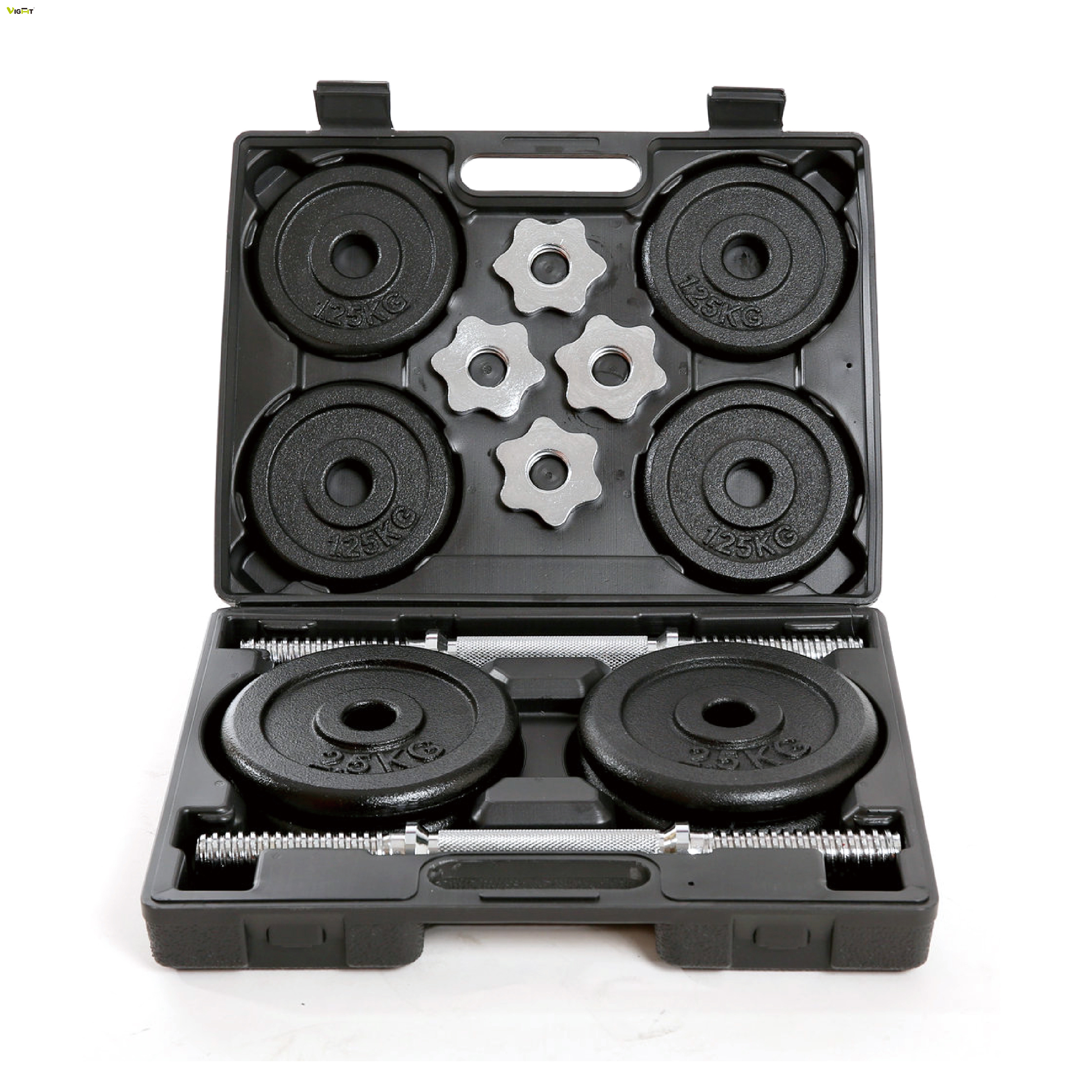
The Dumbbell serves as the absolute baseline for unilateral training. Unilateral movements train one side of the body independently. This makes them ideal for correcting hidden muscle imbalances. Your dominant arm cannot compensate for your weaker arm. They also ensure a safe bailout during muscle failure. You can simply drop them to the floor if a repetition fails. This provides the highest versatility and safety margin for absolute beginners.
The Barbell represents the gold standard for absolute strength. It allows for highly effective progressive overload. It is best suited for bilateral, heavy compound movements. You can perform heavy squats, deadlifts, and bench presses efficiently. You load massive amounts of weight evenly across both sides of your body. However, this tool requires significantly more floor space. You will also need dedicated safety equipment like power racks and spotter arms.
A Kettlebell acts as a unique hybrid tool. It excels at ballistic, momentum-based movements. The center of mass rests outside your grip. This design challenges your leverage continuously. We evaluate it highly for its dual benefit. It builds incredible posterior chain strength while delivering brutal metabolic conditioning. Exercises like heavy swings and Turkish get-ups build explosive hip power. They also elevate your heart rate just as effectively as sprinting.
The Macebell serves as a highly specialized tool. It targets rotational strength and shoulder mobility directly. Most traditional tools focus on linear, up-and-down movements. This long-lever tool forces you to manage a severely offset center of mass. It requires advanced functional fitness to control. Swinging it around your body fortifies your shoulder girdles. It bulletproofs your joints against twisting injuries often sustained in sports or daily life.
Axial loading provides massive, evidence-oriented health benefits. Axial loading refers to weight placed downward through your spine, like during heavy squats. This compression stimulates bone osteoblasts. It improves your overall bone mineral density significantly. It helps prevent osteoporosis later in life. Unassisted movements also reinforce joint integrity. Taking a load through a full, deep range of motion strengthens your connective tissues. Your tendons and ligaments adapt and grow thicker alongside your muscle fibers.
We must map fitness outcomes directly to daily life. A seated leg press makes you better at pushing a sled away from your body. Picking up a heavy iron bell translates much differently. It mimics picking up a heavy box from the floor. You must hinge at the hips, brace your core, and lift. Free-moving exercises replicate these real-world biomechanics perfectly. They train your body to handle unpredictable, shifting loads effectively.
Compound exercises condense your total workout time drastically. You work multiple large muscle groups simultaneously. A freestanding overhead press works your shoulders, triceps, upper back, and core. Doing this via isolation machines would require four separate exercises. Condensing these movements improves your overall return on time invested. You achieve a higher metabolic burn and greater muscle fatigue in half the time.
Table 1: Functional Carryover and Efficiency Matrix
| Fitness Goal | Fixed Machine Example | Free Movement Alternative | Real-World Carryover |
|---|---|---|---|
| Leg Strength | Seated Leg Press | Front Squat | Standing up from a low chair; lifting heavy objects. |
| Pushing Power | Chest Press Machine | Flat Bench Press | Pushing a stalled car; moving heavy furniture. |
| Pulling Strength | Lat Pulldown | Bent-Over Row | Starting a lawnmower; pulling open heavy doors. |
| Core Stability | Ab Crunch Machine | Turkish Get-Up | Maintaining balance on uneven terrain; resisting falls. |
Ego lifting remains the primary cause of training injuries. This occurs when you prioritize weight volume over movement quality. Adding extra weight feels rewarding. However, compromising your form to move that weight destroys your joints. You shift the tension away from the targeted muscle. The stress transfers directly to your lower back, knees, or shoulder capsules. Leaving your ego at the door prevents catastrophic setbacks.
You must establish baseline mobility first. Check your ankle and hip flexibility before squatting. You must also master foundational mechanics before adding any external load. The hip-hinge is the most critical movement pattern to learn. You must learn to push your hips backward while maintaining a neutral spine. You also need to master abdominal bracing. Imagine preparing for a punch to the stomach. Hold this tension. These two mechanics act as mandatory prerequisites for safe lifting.
Safely increasing weight requires a clear, skeptical-friendly framework. Do not guess when to increase your loads. Follow a strict, rule-based approach to mitigate all risks.
Select a Baseline Load: Choose a weight you can lift comfortably for 10 repetitions.
Focus on Form Over Volume: Ensure every single repetition looks exactly identical.
Hit the Repetition Target: Master 3 complete sets of 10 reps with perfect form.
Evaluate Fatigue: If the final rep feels easy and your form holds, you are ready.
Make the Micro-Jump: Jump to the very next weight increment (usually 2.5 to 5 pounds).
Reset the Standard: Begin the process over at the new weight, accepting fewer reps initially if needed.
Some highly technical movements carry higher inherent risks. A heavy deadlift involves complex spinal mechanics. An overhead snatch requires incredible shoulder stability. We highly recommend investing in a few professional sessions first. Hire a certified strength and conditioning coach. Have them observe your movement patterns directly. They will correct micro-errors you cannot see in a mirror. Establishing safe movement patterns early saves you months of frustrating injury rehabilitation.
If you want the highest ROI starting point, start small. We highly recommend investing in adjustable models for home gyms. They offer the lowest possible spatial footprint. They also provide the highest exercise variety per square foot.
They replace an entire rack of fixed weights instantly.
You can train every single muscle group comprehensively.
They allow for tiny weight increments, aiding steady progression.
You can store them completely out of sight under a bed.
Your next progression involves dynamic power. We suggest adding a single, moderate-weight cast iron bell. This opens up entirely new planes of motion.
It introduces momentum management to your routine.
It rapidly develops your posterior chain (glutes, hamstrings, back).
It offers excellent cardiovascular benefits without a treadmill.
It serves as an excellent travel-friendly workout companion.
Advanced trainees eventually require maximum load capacity. Those ready to commit space and budget need a robust setup.
Acquire a standard 45-pound Olympic bar for uniform loading.
Invest in bumper plates to protect your flooring during drops.
Purchase a sturdy squat stand or half-rack for safety.
Ensure you have a flat, stable bench for pressing movements.
Free-moving loads represent the most versatile category of fitness equipment available. They demand high stabilizer activation and deliver incredible functional carryover. They outperform fixed resistance machines across almost every health dimension. This holds true provided the user respects the initial learning curve. Prioritizing perfect biomechanical form mitigates the associated injury risks entirely.
You should audit your current routine or home gym space today. Select your primary fitness goal clearly. Decide if you need unilateral balance, metabolic conditioning, or heavy lifting. Choose the single piece of equipment aligning best with that specific goal. Start light, master the foundational mechanics, and progressively overload your way to profound physical resilience.
A: It depends entirely on the equipment. Unanchored hand weights are easy to drop safely laterally if you fail a repetition. You rarely need a spotter for them. However, heavy barbell bench presses require strict safety measures. The bar traps you if you fail. Always use a power rack with safety arms or utilize a trained spotter.
A: No. Getting bulky requires an intentional, massive caloric surplus over many months. Your hormonal profile also dictates muscle size. Heavy resistance training actually builds dense, lean muscle tissue. It improves your overall body composition and makes you look leaner, provided you maintain a balanced, appropriate diet.
A: They offer superior long-term metabolic benefits. Steady-state cardio burns calories only while you perform the activity. Building lean muscle mass increases your resting metabolic rate permanently. Your body burns more calories 24 hours a day to sustain this new muscle tissue. Combining both yields optimal weight loss results.
A: A minimalist setup requires very little room. An adjustable pair needs roughly a 4x6 foot mat for you to move around comfortably. A full strength base demands significantly more room. You need at least an 8x10 foot dedicated area to safely accommodate an Olympic bar, a power rack, and weight plate storage.


